
1 Stress Peeing Is a Territory Message, Not a Bathroom Problem
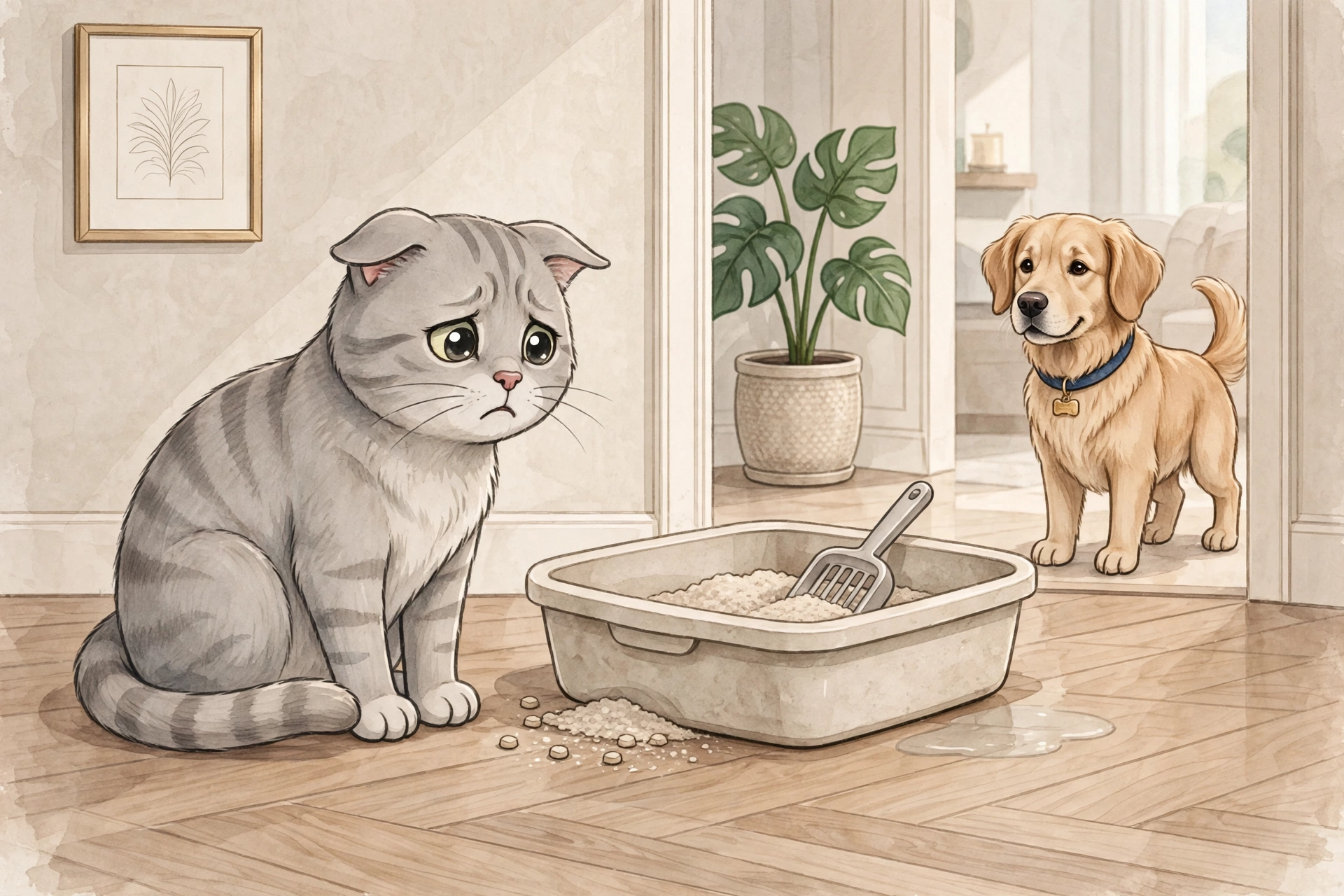
When a cat pees outside the litter box after a new dog arrives, it is almost never about the box itself. It is a chemical announcement. Your cat is using urine to reclaim the space and remind everyone, including itself, that this territory is still theirs.
Cats read a home through scent. Every wall, corner, and piece of furniture is part of a scent map they have carefully built over months or years. A new dog rewrites that map overnight. The cat's response is instinctive: mark, mark, and mark again until the space smells familiar and safe.
2 Why a Friendly Dog Can Still Trigger the Behavior
Owners often assume this only happens with aggressive or pushy dogs. Not true. Even a calm, well-mannered dog can trigger stress marking simply by existing in the cat's space. The dog does not have to do anything wrong.
The trigger is a combination of unfamiliar scent, blocked access to key resources like food or resting spots, and the constant low-grade unpredictability of a new animal moving around the home. A cat that feels its ownership of the space is threatened will use the only tool it has to fight back: its bladder.
3 Rule Out Medical Causes First
Before you treat this as a behavior problem, book a vet visit. Urinary tract infections, bladder crystals, and early kidney issues all cause litter box avoidance and look nearly identical to stress marking from the outside. A quick urinalysis rules these out and gives you the clarity to move forward with a behavioral plan.
If your cat is straining to urinate, producing only tiny drops, or crying while trying to go, treat that as an emergency and see the vet immediately. A blocked bladder is a life-threatening situation, especially in male cats.
4 Three Free Steps You Can Take Today
While you get the vet visit scheduled and prepare a longer plan, put these three things in place right away. They will not fix the underlying issue, but they will reduce the daily damage.
Give the cat a dog-free zone. Choose one room the dog never enters. Put the litter box, food, water, a scratching post, and a comfortable resting spot inside. This becomes your cat's safe base and reduces the constant sense of invasion.
Add more litter boxes, in the right spots. The rule is one box per cat, plus one extra, placed in quiet locations with easy escape routes. A cat that has to walk past the dog to reach the litter box will eventually decide the rug is safer.
Clean marked spots with an enzyme cleaner. Normal household cleaners do not remove the pheromones cats can still smell. Only enzyme-based cleaners break down the proteins in cat urine, and if you skip this step, your cat will return to remark the exact same spot.
5 Why Time Alone Will Not Fix This
Many owners assume the peeing will stop once the cat gets used to the dog. Sometimes it does. Often it does not. Marking is self-reinforcing: once a cat has peed on a spot, the residual scent tells the cat to come back and remark it, even after the original trigger has faded.
This is why cases that seem like they should resolve themselves drag on for months or years. The dog settled in, the cat seems fine socially, and the peeing continues. The habit has decoupled from the trigger and now runs on its own momentum. You have to interrupt the pattern deliberately.
6 The Two-Pronged Fix That Actually Works
Here is the honest truth. Solving this problem requires two moves at the same time. You have to reset the cat's behavioral habit around the litter box, and you have to reduce the trigger by teaching the dog to leave the cat alone.
Do only one, and the problem tends to come back. Do both, and most households see the marking stop within weeks. Below are the two resources we consistently recommend for each side of the plan.
Is Your Cat a Troublemaker?
Stop Cat Spraying Now
A vet-developed behavioral reset for cats already stress peeing in the home. Guaranteed to stop any cat from spraying. Built by veterinarian Susanne Westinghouse over 20+ years of clinical practice, refined with cat behaviorist Martin Ragman.
Get the Cat Spraying No More Guide7 Fixing the Habit With Cat Spraying No More
Cat Spraying No More is the resource we recommend for the cat side of this equation. It was developed by veterinarian Susanne Westinghouse, drawing on more than 20 years of clinical practice, and refined with cat behaviorist Martin Ragman. The result is a step-by-step system that interrupts the marking habit rather than masking it, with a guarantee that it will stop the spraying in any cat.
What it does well is address the specific pattern happening in your home right now: a cat that started marking because of a household change and needs a step-by-step process to unlearn the habit. It walks through litter box setup, scent management, feeding rhythm, and calming routines in a sequence that is easy to follow even if you have never dealt with this before.
8 Fixing the Trigger With Better Dog Impulse Control
The other half of the plan is teaching the dog to ignore the cat. Not just physically, but mentally. A hyper, understimulated dog that fixates on the cat every time it walks by will keep the cat's stress level elevated no matter how many behavioral tools you use on the cat side.
Physical exercise alone does not fix this. A tired dog is not the same as a calm dog. Dogs need mental work to build the impulse control that lets them share a space with a cat without staring, chasing, or pestering. For a complete behavioral reset on the dog, we consistently recommend Brain Training for Dogs, a force-free cognitive program by CPDT-KA certified trainer Adrienne Farricelli. It targets the exact skill your cat needs: a dog that can choose to disengage.
Explore Brain Training for Dogs9 Why the Two-Pronged Approach Works Together
Here is the logic. If you only work on the dog, the cat is still running on the old marking habit and will keep peeing even in a calmer home. If you only work on the cat, the dog keeps triggering fresh stress and the training never fully sticks.
When you address both sides in parallel, the cat's world stops feeling threatened at the same time the marking habit is being unwound. That is the combination that produces lasting results. Most households that commit to both sides see meaningful change inside four to six weeks.
10 What Success Actually Looks Like
Success is not just an empty carpet. It is a cat that walks past the dog without freezing. It is a dog that glances at the cat and looks back at you instead of fixating. It is a shared water bowl area that both animals use without incident.
The end goal is not tolerance. It is peace. Cats and dogs can absolutely share a home comfortably, but only when both sides have the behavioral skills to do it. The stress peeing you are seeing right now is a signal that those skills are missing on both sides, and the good news is that both sides can be taught.
Frequently Asked Questions
Will my cat stop peeing outside the litter box once the dog calms down?
Not always, and this is the trap most owners fall into. Once a cat begins marking a spot, the scent left behind acts as a signal telling the cat to return and remark. The behavior can outlast the original trigger by months. You have to treat both the trigger (the dog) and the ingrained habit (the marking) at the same time for the peeing to stop.
How do I tell if my cat is stress peeing versus having a medical issue?
Book a vet visit first. Urinary tract infections, crystals, and bladder inflammation all cause litter box avoidance and look identical to stress marking from the outside. Once your vet rules out medical causes, you can treat the peeing as a behavioral response to the dog's arrival with confidence.
Can a dog really change how safe my cat feels in its own home?
Yes, more than most owners realize. Cats read a home as a network of scent-marked territories. A new dog rewrites those maps by leaving unfamiliar smells everywhere and blocking access to key resources like food, water, and resting spots. Even a friendly dog changes the cat's sense of ownership over the space, which is often enough to trigger anxiety marking.