
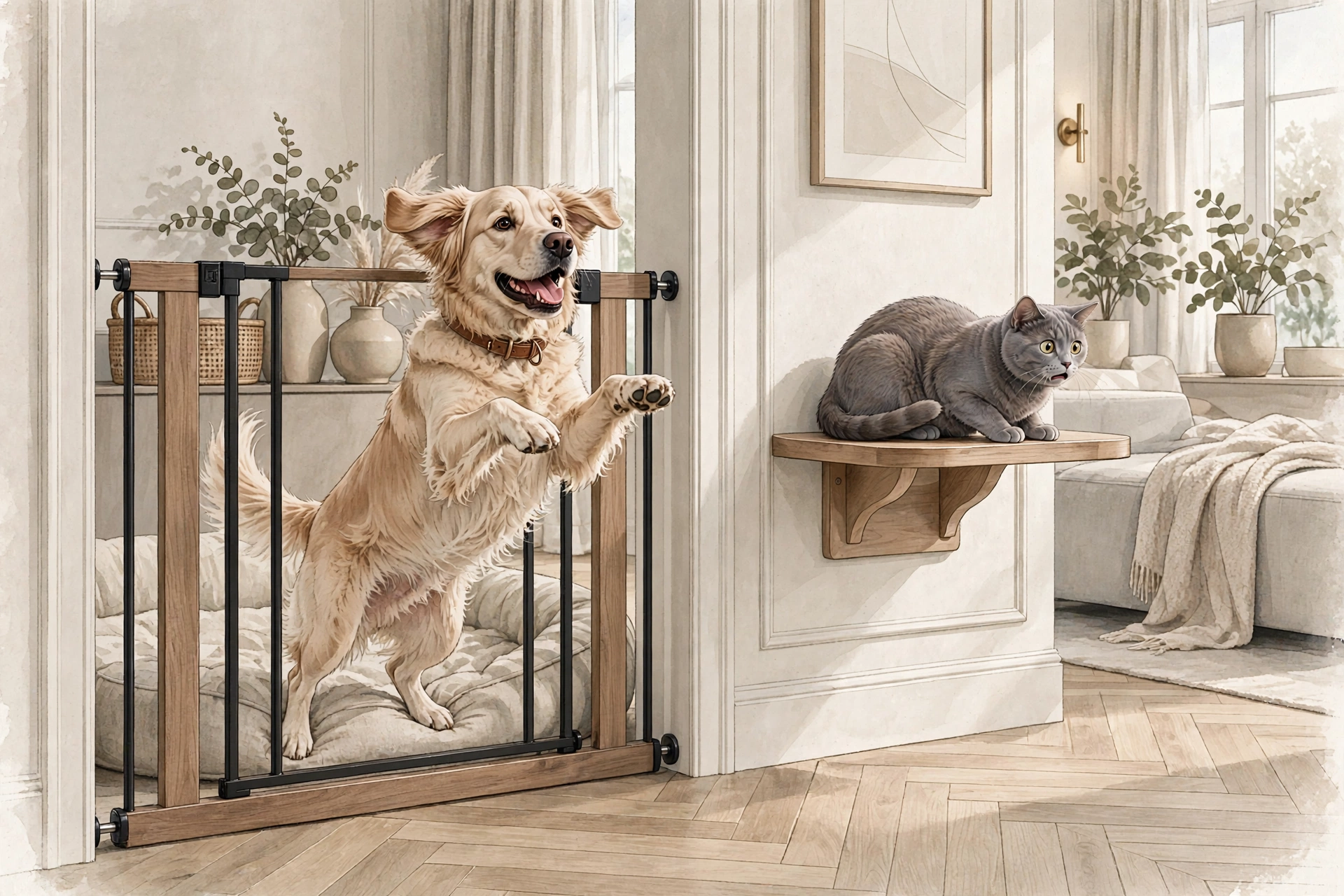
1 A Hyper Dog Is Not Just Annoying, It Is a Real Threat to Your Cat's Wellbeing
Owners often see a hyper dog as a nuisance. The truth is more serious. Chronic low-grade harassment from a high energy dog quietly damages your cat's health in ways that take months to show up.
A cat that lives in a state of constant alert eats less, drinks less, moves less, and spends most of the day hiding. Prolonged stress in cats increases the risk of urinary problems, digestive issues, over-grooming, and even immune suppression. This is not a personality clash. It is a slow-motion welfare problem.
2 Why Physical Exercise Is Not Enough
Here is the mistake most owners make. They assume a tired dog is a calm dog and try to solve the problem with longer walks, bigger backyards, or more fetch. It rarely works, and often makes things worse.
Physical exhaustion builds fitness, not calm. A dog that burns off physical energy without mental engagement often comes home in a state of heightened arousal, ready for the next thrilling target. That target is very often the cat. The dog is not misbehaving. It has simply been trained by accident to see the cat as an outlet.
3 The Stress Signals Cats Give That Owners Miss
Cats do not shout. They whisper their distress through small, easy-to-miss changes in daily behavior. Learning these signals lets you catch the problem before it hardens into a full-blown behavior issue.
Watch for these signs:
- Hiding more than they used to, especially in high spots or closets
- Eating quickly and only when the dog is out of the room
- Over-grooming, particularly on the belly or inner legs
- Ears flattening whenever the dog moves nearby
- Skipping the litter box or peeing in unusual spots
- Sudden aggression when picked up or approached
Any two of these together deserve your attention. All of them at once means your cat is already deep into chronic stress and needs help now.
4 Three Free Things You Can Do Today
Before we get to the training piece, put these three changes in place immediately. They lower the daily pressure while you work on the longer plan.
Give the cat elevated escape routes. Cat trees, wall shelves, or even a clear path over furniture that the dog cannot follow. Vertical space is a cat's most reliable safety strategy in a shared home.
Feed the cat somewhere the dog cannot reach. A raised counter, a room with a baby gate, or a top-of-fridge station. A cat that has to eat with a dog watching will start skipping meals or eating too fast.
Use a leash indoors during high energy moments. A house leash attached to your belt gives you instant control when the dog starts fixating. It stops the chase before it starts and breaks the habit loop.
5 The Real Fix: Mental Work That Builds Impulse Control
The behavior we actually want from the dog is not exhaustion. It is choice. We want a dog that sees the cat, feels the impulse, and decides not to act on it. That skill is called impulse control, and it is built through mental training, not physical exercise.
Dogs that get regular problem-solving work develop the neural circuitry for pausing, thinking, and choosing. It shows up everywhere. They stop pulling on leash. They stop counter-surfing. And they stop chasing the cat. Fifteen minutes of brain work a day tends to produce more real-world calm than an extra hour at the dog park.
6 Why We Recommend Brain Training for Dogs
 Sponsored
One of the best cognitive frameworks we have seen for this exact problem is Brain Training for Dogs, a force-free course developed by Adrienne Farricelli, a CPDT-KA certified trainer. It is not a series of tricks. It is a structured progression of mental games designed specifically to build the impulse control muscle.
What makes the program work is the sequence. It starts with foundational obedience that reinforces the dog's ability to focus on you, then layers in problem-solving puzzles that require the dog to think before it acts. Over time, that thinking pause becomes automatic. When the cat walks into the room, the dog's brain runs a quick internal check instead of launching straight into a chase.
The modules that matter most for a cat household are the impulse control games and the polite manners section. Both directly retrain the dog's default response to sudden movement, which is the exact trigger that sets off cat chasing. The exercises are short, five to fifteen minutes each, so they fit into a regular day without turning training into a chore.
The program moves through escalating challenges that engage the dog's problem-solving brain. The result, in practical terms, is a dog that can lie down while the cat crosses the room, that disengages when you say the word, and that stops treating the cat as prey theater. For a hyper dog living with a cat, that is the transformation you need.
Expect small shifts in the first week, real behavior change by week three, and durable habits by week six. Some dogs are faster, some slower. What matters is consistency, not intensity. Fifteen minutes done every day beats an hour done twice a week, every time.
The other thing worth knowing is that the training works on adult dogs, not just puppies. Older dogs often move faster through the impulse control modules because they already have basic obedience in place. You are not starting from zero. You are giving your dog the missing piece that stops the cat harassment from being a daily problem.
Explore Brain Training for Dogs7 The Warning Every Cat Owner Needs to Hear
Here is the part most articles skip. If your dog has been stressing your cat for more than a few weeks, there is a very good chance your cat has already started marking somewhere in the house. Maybe you have not found it yet. Maybe you found one spot and cleaned it, thinking the problem was over.
Once a cat starts stress peeing, the behavior develops its own momentum. The scent from marked spots signals the cat to return and remark, even after the dog calms down. Calming the dog is essential, but it does not automatically undo the marking habit. That has to be treated separately, and quickly, before it becomes permanent.

Is Your Cat a Troublemaker?
Stop Cat Spraying Now
The emergency reset for cats whose stress marking has already started. Guaranteed to stop any cat from spraying. Built by veterinarian Susanne Westinghouse over 20+ years of clinical practice, refined with cat behaviorist Martin Ragman.
Get the Cat Spraying No More Guide8 Cat Spraying No More: The Companion Resource
For a complete behavioral reset on the cat's side, we highly recommend Cat Spraying No More. It was developed by veterinarian Susanne Westinghouse from more than 20 years of clinical practice, in collaboration with cat behaviorist Martin Ragman. Their unique approach comes with a guarantee that it will stop any cat from spraying, and it is specifically built for the scenario you are living right now, a cat that has started marking because another animal invaded its space.
The guide walks through litter box placement, scent management, calming rituals, and a daily reset routine that interrupts the marking pattern quickly. Paired with the dog side of the plan, it addresses the cause and the symptom at the same time. That is what actually restores peace to the household.
9 Realistic Timelines and What to Expect
Give this plan four to six weeks before judging it. In the first week or two, you will likely see the dog start to settle after training sessions and the cat begin to venture out during the day again. In week three or four, the cat's litter box use tends to normalize. By week six, most households report meaningful, sustained peace.
Some days will feel like backsliding. Expect that. Consistency beats intensity every time. Fifteen minutes of brain work daily, done every day, produces far better results than an hour of training twice a week.
10 Protecting the Cat's Peace Is the Whole Point
It is easy to make this story about training the dog. The real story is about protecting your cat's peace. Cats came into your home first. They deserve a space where they can eat, sleep, use the litter box, and move around without being ambushed.
When you calm the dog with real mental training and reset the cat with a proven behavioral system, you are not just solving a nuisance. You are restoring a home where both animals feel safe. That is the goal every multi-pet household should aim for, and it is absolutely reachable.
Frequently Asked Questions
Why does my dog not get tired even after long walks?
Physical exercise burns energy but does not build calm. Many high energy breeds need mental problem-solving to actually settle. A dog that runs for an hour and then paces the house afterward is telling you its brain never got engaged. Short daily brain sessions often produce more real calm than doubling the walk length.
How do I know if my cat is being stressed by the dog?
Watch for the small signs. Hiding more than usual, eating at odd hours to avoid the dog, over-grooming, flattened ears when the dog moves nearby, or urinating outside the litter box are all classic stress signals. Cats rarely show stress dramatically. They show it through small changes to daily rhythms.
Can a dog and cat really become friends, or is peace the best I can hope for?
Some dog and cat pairs become genuinely close, sleeping together and grooming each other. Many others reach comfortable coexistence, sharing space without stress. Both outcomes are wins. What is not okay is chronic low-grade tension, which slowly wears down the cat's health and often ends in litter box problems.